Tuesday, April 21, 2020

PROCESS OF SHIFTING OF REGISTERED OFFICE FROM ONE STATE/UT TO ANOTHER

A Company shall have a registered office within 30 days of its incorporation. It is the official address of the company incorporated under the provision of Companies act 2013  or under any previous company law. The procedure to change the registered office of the Company from one State or union territory  does not only involve change  from one state or Union Territory to another but also involves change of Jurisdiction of Registrar of Companies (ROC). Only Tamil Nadu & Maharashtra have two ROC.  


The procedure to change the registered office from one State or Union Territory to another is specified under the provision of Section 12(4) read with Rule 30 of Companies(Incorporation) Rules, 2014 which is in step by step form is as follow:-

1. CONVENING BOARD MEETING- Hold Board meeting as per the provisions of SS-1 & Companies Act 2013:-
  • Consider proposal for shifting of registered office.
  • Alteration of Memorandum of Association (MOA) & Articles of Association(AOA), of Company.
  • Approving the notice calling Extra Ordinary General Meeting and fix its, date, day, time, venue etc. 
  • Authorizing  Company Secretary or Director to move application to Regional Director.
2. CONVENING EXTRAORDINARY GENERAL MEETING- Pass Special Resolution and file the certified copy of the  same in E Form MGT-14 with in 30 days of its passing at Extra Ordinary General Meeting with the following attachments- 

  • Altered copy of MOA & AOA
  • Copy of special resolution along with explanatory statement. 
3. PUBLICATION of ADVERTISEMENT- The  Company, shall atleast 30 days before filing application to Central Government (Regional Director) , publish an advertisement in E Form INC-26 in two newspapers -

1) in the vernacular newspaper in the vernacular language ,and
2) in English newspaper with wide circulation in English language
           
           in the state where the registered office is situated.

A copy of such advertisement shall be forwarded to-

  • Regional Director,
  • Debenture Holders and creditors of the company,
  • Registrar of Companies 
  • SEBI, in case of listed company,
  • Any other regulatory Authority, if Company is regulated by Special law or Act.
4. PREPARATION OF LIST OF CREDITORS AND DEBENTURE HOLDERS- A list of creditors and debenture holders, not less than one month old from filing application for change of registered office, is prepared which shall :-set forth the following details:-


  • The name and address of each creditor and debenture holders,
  • The nature and amount of debts, claims or liabilities due to them. 

Declaration- Such list of creditors and debenture holders shall be accompanied by Company Secretary and two directors , one of whom shall be the managing director, if any stating-

a) they have made full enquiry into the affairs of the Company and having done so have concluded that the list of creditors are correct and the estimated value given in the list of debt or claim payable on a contingency or not ascertained, are proper estimate of value of such  debt or claim and there are no debts or claims against the company to their knowledge

b) No employee shall be retrenched as a consequence of shifting of registered office from one state to another

5. SUBMIT APPLICATION TO REGISTRAR AND CHIEF SECRETARY- A copy of application shall be submitted to Registrar of Company and Chief Secretary of the concerned State or Union Territory.

6. FILING OF APPLICATION- An application in Form INC-23 shall be filed to Central Government (Regional Director) along with the following enclosures-

a) Copy of altered MOA,
b) Copy of minutes of ExtraOrdinary General Meeting,
c) Copy of Board resolution, Power of attorney or Vakalatnama.
d) Copy of Newspaper advertisement
e) Copy of list of creditors and debenture holders
f) Declaration by Company Secretary or two directors , one of them shall be Managing Director , if any.
g) Copy of acknowledgement of service of application to Registrar and Chief Secretary of State Government /Union Territory.
h) Copy of each objection, if any,  received by Company and its reply to the objection.

In case no objection is received by the company- The application may be put up for orders and the order either approving or rejecting the application shall be passed with in 15 days of receipt of application.

In case objection is received by the Company- The Regional Director shall hold hearing and direct the Company to file an affidavit to record the consensus reached at the meeting and shall approve the shifting within 60 days from filing the application.

* Where no consensus is reached, the Company shall file an affidavit specifying the manner in which the objection is to be resolved with in definite time frame, reserving the original jurisdiction to the objector for pursuing its legal remedy, even after the registered office is shifting, the Central Government(Regional Director) shall pass an order confirming or rejecting the shifting within sixty days from filing of application.

7. ORDER PASSED BY REGIONAL DIRECTOR- The Regional Director shall pass any order as may think fit and can impose such  cost as it may think proper.

8. FILING OF E FORM INC-28- The applicant shall file an E form  INC- 28 with Registrar for registration of order passed by Regional Director,  within  30 days of receipt of certified copy of order confirming shifting of registered office. 

9. FILING OF E FORM INC-22-  The notice of change of registered office shall be file in E form -22 along with requisite fees within a period of 15 days from confirmation of shifting of registered office with following documents- 


  • the registered document of the title of premises of the registered office in the name of company,
  • notarized copy of lease or rent document along with rent receipt of mot less than one month old, in the name of Company,
  • authorization from owner or authorized occupant to use premises as registered office,
  • utility bill depicting the address of the premises in the name of owner or authorized occupant which is not 2 months old. 
NOTE- The shifting of registered office shall not be allowed if any inquiry, inspection or investigation, has been initiated against the company or any prosecution has been pending against the company under the Act. However, on completion such inquiry, inspection or investigation , the shifting shall be allowed. 

For any clarification, drop email @ shailja.tiwari16@gmail.com


Friday, April 10, 2020

SECTION 8 COMPANIES- A COMPLETE BACKGROUND

Section 8 Companies (Section 25 of Companies Act 1956) , can be registered under Companies Act 2013 having a charitable purpose with limited liability but without the addition of the word 'Limited' or 'Private Limited' to its name. 

Section 8 Company - Old Section 25 Company - IndiaFilings

In India, there are basically following three forms of Non Profit organisations(NGO) registered under various Acts-
  • Trusts formed under India Trust Act 1882,
  • Societies registered under Section 20 of Societies Registration Act 1860,
  • Section 8 Companies under Companies Act 2013.

 SECTION 8 COMPANIES

  • Any person or association of persons desirous of incorporating with limited liability having following features:-
a) has objects like promotion of commerce, arts, science , education, research, social welfare, religion, charity, protection of environment or any such other object.

b) apply its profit or other incomes in promoting its objects.

c) prohibition on the payment of dividends to its members.

may make an application to grant registration under Section 8 of the Act.

  • The Company under Section 8 shall have all privileges and liabilities as any other company registered under any other provisions of the Act. 
ALTERATION OF MEMORANDUM & ARTICLES OF ASSOCIATION OF SECTION 8 COMPANY

Any alteration in any provision of Memorandum of Association or Articles of Association of Section 8 company can only be done with the prior approval of Central Government. 


PROCEDURE FOR INCORPORATING SECTION 8 COMPANY

1. An application shall be made to Registrar of Companies in Spice+(Simplified Proforma for Incorporating Company Electronically- INC-32) along with such fees as prescribed under rules.

2. The said application shall be accompanied by following documents-

  • The Memorandum and Articles of Association  of the proposed company in Form No.- INC -13. 
  • A declaration in Form No. INC-14 by an Advocate, Chartered Accountant , Cost Accountant, Company Secretary in Practice , that the memorandum and articles are in conformity with the  Act and Rules made there under and all the requirements under the Act & Rules have been properly complied regards to section 8.
  • An estimate of income and expenditure for next 3 years specifying source of income and objects of expenditure.
  • A declaration by all applicants in Form No. - INC- 15
ISSUANCE OF LICENSE-  The Central Government may by  licence allow the person or association of person to register as Section 8 company and thereupon, Registrar shall register the company , if  the application is complete in all form and impose such conditions as think fit, 

CONVERSION OF SECTION 8 COMPANY INTO A COMPANY OF ANY OTHER KIND

1. Special resolution- A company registered under section 8 with intend to convert itself into a company of any other kind shall pass a special resolution at a general meeting for approving such Conversion

2. Explanatory Note- The explanatory statement annexed the notice convening the extraordinary general meeting shall set out the following reasons for such conversion

A) The date of incorporation of the company,
B) The principal object of the company as set out in the memorandum of association,
C) The reasons as to why the activities for achieving the objects of the company cannot be carried out  as Section 8 company,
D) The principal or main objects of the company are proposed to be altered , what would be the ultimate object and the reason for the alteration
E) The privileges or confessions currently enjoyed by the company such as tax Exemptions , approval for receiving donations or contributions , land and other immovable property if any acquired by the company at concessional rates,
F) Details of impact of the proposed conversion on the members of the company including details of any benefits that may accrue to the member as a result of the conversion.

3. Filing of Form No. MGT-14 with Registrar of Companies- A certified true copy of the special resolution along with a copy of notice and explanatory statement shall be filed with the registrar in form No.- MGT 14 with in 30 days of passing such resolution. 

4. Filing of Form No. INC.18 with Regional Director- The company shall file an application in with the Regional Director in Form No. INC.18  along with such fees as may be prescribed. 
The application shall be accompanied by :-

  • Certified true copy of the special resolution ,
  • Copy of notice convening the meeting including the explanatory statement ,
  • Proof of serving the notice to all the authorities.


5. Copy of application to Registrar of Companies- A copy of the application filed with the Regional director shall also be filed with the concerned Registrar of Companies.

REVOCATION OF LICENCE

1) The Central Government is empowered to pass an order for revocation of license granted to a company registered under this section if it contravenes any of the requirements of this section or any of the conditions subject to which a license is issued or the affairs of the company are conducted fraudulently or in a manner violative of the objects of the company and prejudicial to public interest.

2) No such order can be passed unless the company is given a reasonable opportunity of being heard.

3) A copy of every such orders should be given to registrar of companies.

4) The Central Government is empowered to pass an order either to wound up the company under this act or amalgamated with another company registered under this section.

  • If the company is amalgamated, then Central Government may by order provide for such amalgamation to form a single company which such Constitution , properties, right ,interest , authorities and privileges along with liabilities , duties and obligations as may be specified in the order.
  • If the order of winding up of a company has been passed under this section, then after the satisfaction of its debts and liabilities, any asset may be transferred to another company registered under this act section and having similar objects subject to such conditions as the tribunal may impose or maybe sold and the proceeds thereof shall be credited to the Insolvency and Bankruptcy fund formed under section 224 of the Insolvency and Bankruptcy Code 2016.

CONSEQUENCES OF NON COMPLIANCE 

If the company makes any default in complying any of the provisions of this section then the :- 

Company - shall be liable for the fine not less than 10,00,00 rupees extending up to 1,00,00,000 rupees .

Directors and every Officer in default - shall be punishable  with imprisonment for a term up to 3 years or with fine Not less than 25,000 rupees  but which may extend to 25,00,000 rupees or with both

If it is proved that the affairs of the company were conducted fraudulently then  every officer in default shall be liable for action against section 447. 

CERTIFICATION AND REGISTRATIONS 

1) 80G CERTIFICATE FROM INCOME TAX- 80 G certificate is issued to section 8 company by the income tax department. It gives the donor of section 8 company an exemption for his donation under  the income tax.

2) 12A REGISTRATION-  12A is a one time for registration which exempts the Section 8 company to pay income tax on the income earned by such company.

3) FCRA REGISTRATION- FCRA registration is required for those Section 8 companies which are desirous of receiving foreign contribution for the objects specified in the memorandum of association. 


For any query or clarifications , drop email at shailja.tiwari16@gmail.com


Tuesday, March 31, 2020

ICSI AUDITING STANDARDS


ICSI - Auditing Standard


The Auditing Standards were formulated by Auditing Standard Board of Institute of Company Secretaries of India  and issued by Council of ICSI.

These Auditing Standards is effective from 01, July 2019 but on re commendatory basis , these are made mandatory from 01, April , 2020.

These standards are applicable for audit by Practicing Company Secretaries.

AIM OF ICSI AUDITING STANDARDS

It aims to support company secretaries to develop-
                        auditing acumen,
                        techniques and tools, and,
                        inculcate best auditing practices,
while conducting an audit. 

PARTS OF AUDITING STANDARDS


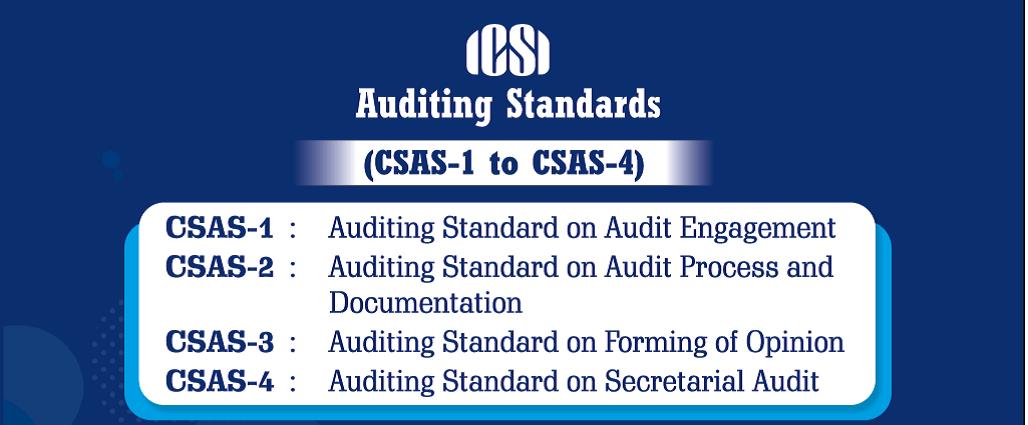
These ICSI auditing standards are divided into 4 parts:-


1. CSAS-1- Auditing Standard on Audit Engagement
2. CSAS-2- Auditing Standard on Audit Process & Documentation.
3. CSAS-3- Auditing Standard on Forming of Opinion.
4. CSAS-4- Auditing Standard on Secretarial.


CSAS-1

AUDITING STANDARDS ON AUDIT ENGAGEMENT

The Auditing standard on Audit Engagement deals with Auditor's roles and responsibilities with respect to Audit Engagement and the process of entering into agreement with the appointing authority for the purpose of audit.

Applicability- Audit Engagements accepted by the Auditor on or after 01, April, 2020.

AUDIT ENGAGEMENT PROCESS

Pre-Engagement Meeting- Before accepting the Audit Engagement, the Auditor shall have the pre engagement meeting with the Auditee to discuss terms of engagement, prior year audit findings and conclusions, appropriateness of legal framework, internal control system, commercial terms of Audit and timeliness and milestone , if any for conducting audit and submitting its report.

Appointment- The appointment of auditor shall be in accordance with applicable laws, acts, rules and regulations, standards and guidelines and if no manner is given, then by manner made by the Appointing Authority.

Certificate- The Auditor shall submit an eligibility certificate before accepting an audit ,which includes 
a) The number of audits are within the ceiling limits by ICSI.
b) No substantial conflict of interest.
c) No restriction to render professional services.
d) He is not debarred to take audits in any other law,

Audit Engagement Letter- The Auditor shall obtain an Audit Engagement letter along with the copy of resolution and shall provide his acceptance to the appointing authority.

Communication to the Previous Auditor- The Auditor shall communicate with the previous auditor, in any before accepting the audit. Communication may be sent be registered AD , courier , by hand or by an email. Auditor shall wait for 7 days before accepting an audit.


Limit of Audit Engagement- The Auditor shall accept Audit Engagement with in the limits prescribed under any law being in force or by ICSI.

ICSI has presribed following limits:-

  • 10 secretarial audits by PCS/partner
  • An additional 5 audits by partner/PCS ,if unit is peer reviewed.
Conflict of interest- The Auditor shall not have any substantial conflict of interest with the auditee and any conflict of interest , other than substantial conflict of interest may be disclosed to the auditee.

The conflict of interest explained below shall not be constructed as substantial conflict of interest:-

  • Auditor holding not more than 2% of  paid up share capital or shares of value Rs. 50,000.
  • Auditor indebted for an amount not more than Rs. 5,00,000.
  • Auditor was in employment more than 2 years ago.

Confidentiality- The Auditor shall not disclose the information obtained during Audit without proper and specific authority or unless there is a legal obligation to disclose.

Changes in terms of Engagement- The Auditor shall not agree to a change in terms of employment without any proper justification.
 If terms of engagement are changed, the Auditor and Appointing Authority shall agree to the new engagement by way of supplementary deed or any other suitable form in writing.

CSAS-2-
AUDITING STANDARDS ON AUDIT PROCESS AND DOCUMENTATION

It deals with the responsibilities and duties of Auditor with respect to process of conducting audit and maintaining proper documents including working paper files.

Objective- The objective of standard is to prescribe a Principle for an Auditor

  •  To conduct an audit as per the prescribed audit process.
  •  To maintain documentation that provide: 
            A : sufficient and appropriate records that form part of the                       Auditor's Report, and

             B: evidence that audit was planned and performed as per                   applicable Auditing Standards ans statutory requirements.


1) Audit Planning- Audit Plan is very crucial and should be designed with due care. The Auditor shall prepare an audit plan, which shall include detailed layout for conducting audit procedures, timings, sample sizes basis of sampling, etc. Audit Planning involves establishing the overall audit strategy for the engagement and development of Audit Plan. 

2) Risk Assessment- The Auditor shall evaluate high risk areas and activities of the Auditee with respect to :- 
a) Internal Control System,
b) Transparency, prudence and probity,
c) Changes in the compliance team.

3) Information about the Auditee- The Auditor shall obtain sufficient information about the Auditee for conducting the Audit which may include:-

  • Nature of business of Auditee,
  • Sector in which the Auditee operates,
  • Size of the business of Auditee,
  • Media Reports
  • Laws applicable to business of Auditee.
4) Audit Check-lists- The Auditor shall use systematic and comprehensive check list for carrying out the Audit and to verify the compliance requirement. 

5) Collection and verification of Audit Evidence- The Auditor shall verify compliance with applicable laws, rules, regulations & standards. Any deviation shall be recorded.

6) Documentation-  Documentation of Audit evidence supports audit conclusions and confirms that audit was carried out in the scope of audit. It shall take place through out the Audit process. 

7) Record Keeping & Retention- The Audit document shall be collated for records within a period of 45 days from the date of signing of Audit Report and shall be retained for a period of 8 years from signing of such report. 

CSAS-3
AUDITING STANDARD ON FORMING OF OPINIONS

Objective - Auditing Standards on forming of opinion deals with basis and manner of forming an opinion by the Auditor on the subject matter of the Audit and express his conclusion through the written report.

1) Process of Forming an opinion:- The Auditor shall consider materiality while forming its opinion and adhere to

  • The Principle of Completeness 
  • The Principle of Objectivity
  • The Principle of timeliness
  • The Principle of Contradictory Process
2) Judgement, Clarification  and Conflicting Interpretation- While forming an opinion the Auditor shall consider decided case laws, clarifications issued, opinions framed in similar type of Audit.

3) Precedence and Practices- Precedence and Practice in relation to Audit implies that Auditor shall evaluate on the basis of general and ongoing practice and procedure.

4) Form of an opinion- There are two types of opinion

a) Unmodified opinion- The Auditor concludes that 
  • Due compliance with applicable laws
  • Records are free from misstatement
b) Modified opinion- The Auditor Concludes that
  • Non Compliance of applicable laws
  • Records are not free from misstatement
5) Format of Report- The Report shall be addressed to appointing authority unless otherwise specified in Engagement letter. 
Signature block shall mention the name of the audit firm along with the registration number, certificate of practice number, whether ACS or FCS. The Audit Report shall be prepared in detail. 

For any clarification or queries, drop email at shailja.tiwari16@gmail.com.


Thursday, March 26, 2020

COMPOUNDING OF OFFENCES UNDER COMPANIES ACT 2013

MEANING OF OFFENCE

The term offence is not defined under Companies Act 2013 but in general parlance an "OFFENCE" means  a breach of rule or law. However as per Section 3(38) of General Clauses Act 1897, an offence” shall mean any act or omission made punishable by any law for the time being in force. Offences are generally classified into  Civil or Criminal offences which are further classified as  COMPOUNDABLE OR NON COMPOUNDABLE OFFENCES. 


MEANING OF COMPOUNDING
Compounding of any offence is a process where a person or Company committed  default files an application to the concerned compounding authority for accepting the default and request to condone.  There is no specific meaning of the word "compounding" given under the Companies Act 2013 but in legal sense "compounding " means making good of a default.


ADVANTAGES OF COMPOUNDING

1) The officer in default need not personally present for making good the default as in case of prosecution under the criminal cases the defaulter has to appear before the Magistrate.


2) Compounding is a less time consuming process.


3) The defaulter can be discharged from its liability on payment of certain fees which cannot be more than the fees prescribed under the act and also cannot be treated as penalty.


COMPOUNDABLE  OFFENCES


Not all offences under Section 441 of the the Companies Act 2013 can be compounded. As per 441(1) as amended by the Companies (Amendment Ordinance) 2018 dated 02.11.2018 any offence  punishable under this act (whether committed by a Company or any officer thereof) (not being an offence punishable with imprisonment only , or punishable with imprisonment and also with fine) may either before or after the institution of any prosecution be compounded. 

As per Section 441(6) , any offence which is punishable under this act with imprisonment only or with imprisonment and also with fine shall not be compoundable. 


JURISDICTION FOR FILING PETITION OF COMPOUNDING 

Amount of fine upto Rupees 25 lakhs - Regional Director or any officer authorized by Central Government. 

Amount of fine exceeds Rupees 25 lakhs-    By National Company Law Appellate Tribunal.


WHO CAN FILE THE APPLICATION OF COMPOUNDING


1) Company,or,

2) Officer in Default

"Officer in default" for the purpose of any provision in this Act which enacts that an officer of the Company who is in default shall be liable to any penalty or punishment  by way of imprisonment, fine or otherwise. Officer in default means any of the following officers of company, namely

  • Whole Time Director;
  • Key Managerial Personnel;
  • When there is no key managerial personnel, such director as specified by the Board and who has or have given his or their consent in writing to the Board to such specification, or all the directors, if no director is so specified;
  • any person, who under the immediate authority of the Board,or any key managerial personnel ,is charged with any responsibility including maintenance, filing or distribution of records, authorities, actively participants in, knowingly permits, or knowingly fails to take active steps to prevent any default;
  • any person in accordance with whose advice, directions or instructions the Board of Directors of the Company is accustomed to act, other than a person who gives advice to the Board in a professional capacity;
  • every director, in respect of contravention of any provision of this Act, who is aware of such contravention by virtue of the receipt by him of any proceedings of the Board or participation in such proceedings without objecting to the same , or where such contravention had taken place with his consent or connivance;
  • in respect of the issue or transfer of any shares of a company, the share , transfer agents, registrars and merchant bankers to the issue or transfer;

PROCEDURE TO COMPOUND AN OFFENCE UNDER COMPANIES ACT 2013

1. Call a Board Meeting and make good of a default.
2. Pass Board Resolution to file an application to concerned compounding authority and authorizing any person to file and sign compounding application.
3. File Application in E -Form GNL-1 with Registrar of Companies electronically. This e-form will be forwarded to Regional Director/NCLT or any officer authorized by Central Government, as the case may be.
4. The concerned authority will pass appropriate speaking orders.  


POST COMPOUNDING OF AN OFFENCE

Where any offence has been compounded before or after institution of any offence, intimation shall be given to ROC  with in seven days from the date such offence is so compounded.

Where any offence has been compounded before institution of any offence, no prosecution shall be filed either by ROC or by any shareholders or by any person authorized by the Central Government.

Where any offence has been compounded after institution of any offence, such compounding shall be brought to the notice of the court where such prosecution of such offence.

PENAL PROVISIONS

Any officer or employee of company , who has failed to comply with the order made by the Tribunal or Regional Director or any person authorized by Central Government , shall be punishable with imprisonment which may extend to six months, or fine not exceeding six months or with both.

For any clarifications or queries, drop email at shailja.tiwari16@gmail.com


Wednesday, September 25, 2019

Extension of date for filing BEN-2

The Ministry of Corporate Affairs vide its General Circular No. 10/2019 dated 24.09.2019 has extended the last date to file e form BEN-2 upto 31.12.2019 without payment of additional fees. Thereafter, fee and  additional fees will be charged.

Consequent to the extension of BEN-2, the date of filing BEN-1 will be constructed accordingly.

The circular dated 24.09.2019 is available here:

http://mca.gov.in/Ministry/pdf/GeneralCircular_24092019.pdf

For further clarification, drop email at shailja.tiwari16@gmail.com

Tuesday, June 25, 2019

REMEDY AVAILABLE TO DISQUALIFIED DIRECTOR

MCA has marked large number of Directors as Disqualified by deactivating their DINs and digital signatures. These measures were taken in respect of those companies which have not filed their financial statement or annual returns with Registrar of Companies as per the provisions of Companies Act.

 MCA has struck off the name of Companies for such non compliance and made the directors of such companies as disqualified as per the provisions of Section 164(2)(a) which states that

  (2) No person who is or has been a director of a company which—

 (a) has not filed financial statements or annual returns for any continuous period of three financial years;

 or (b)...

shall be eligible to be re-appointed as a director of that company or appointed in other company for a period of five years from the date on which the said company fails to do so.

So, once a director is disqualified under section 164(2)(a) he cannot be appointed or re-appointed  as director in all companies in which he is a a director for a period of five years and consequently has to vacate the office as per Section 167 of the Act. Section 164(2) is somewhat similar to Section 274(1)(g) of Companies Act 1956, but this old section does not apply to private companies. 


REMEDY AVAILABLE WITH DISQUALIFIED DIRECTOR

As per Companies (Appointment and Qualification  of Directors) Rules 2014, an application for removal of disqualification can be made in Form DIR-10 with appropriate authority. the procedure to file DIR-10 is yet not given. Only the physical form is available.

The option available for disqualified director is to file a Writ Petition in Hon'ble High Court for interim stay on disqualification  and reactivation of  DIN and digital signatures.

Steps to file Writ Petition in High Court


1. Drafting of Writ Petition.

2. Filing the same along with annexures and affidavits to High Court. 

3. Appearance by Advocate and pleading for the same.

4. Obtaining final order from High Court.

5. If order in favour, then file the same with Registrar of Companies.

6. DIN activation


Till today, various High Courts of the Country has passed various order and gave interim stay on the disqualification and activation of DIN and DSC. The final decision is still in Court and may be decided soon. 

So, the disqualified director can approach the concerned High Court for grant of interim stay or other reliefs .

For further Clarification, drop email at shailja. tiwari16@gmail.com


Thursday, May 30, 2019

GUIDANCE NOTE ON SIGNIFICANT BENEFICIAL OWNERSHIP


MCA has replaced Significant Beneficial Rules 2018 and come up with  Companies (Significant Beneficial Ownership) Amendment Rules, 2019 on 08.02.2019 in order to curtail the misuse of various multi layered entities and protect various benami & money laundering Transactions.

If the registered shareholder is not the beneficial shareholder of the company then the registered and beneficial shareholder is required to make a declaration with the Company and the Company in turn shall file a return to Registrar of Companies. Provision of Section 90 of Companies act 2013 along with rules will apply.


Significant Beneficial Owner(SBO)

A person is considered as Significant Beneficial Owner if he is acting alone or together with more persons or trust holds a beneficial interest of 10% or more, (earlier it was 25%).

The Amended Companies (Significant Beneficial Owners) Amendment Rules, 2019 describes Significant beneficial owner” means an individual referred, who acting
a)     alone or together, or
b)     through one or more persons or
c)     trust,
d)     possesses one or more of the following rights or entitlements in such reporting company, namely:-
                                     i.   holds indirectly, or together with any direct holdings, not less than ten percent of the shares;

                                   ii.          holds indirectly, or together with any direct holdings, not less than ten per cent of the voting rights in the shares;

                                 iii.          has right to receive or participate in not less than ten per cent. of the total distributable dividend, or any other distribution, in a financial year through indirect holdings alone, or together with any direct holdings;

                                 iv.          has right to exercise, or actually exercises, significant influence or control, in any manner other than through direct holdings alone:

WHEN DOES THE INDIVIDUAL CONSIDERS AS HOLDING RIGHT OR ENTITLEMENT IN THE COMPANY?

An individual shall be considered to hold a right or entitlement directly in the reporting company, if he satisfies any of the following criteria,

a)     the shares in the reporting company representing such right or entitlement are held in the name of the individual;

b)     the individual holds or acquires a beneficial interest in the share of the reporting company under section 89, and has made a declaration in this regard to the reporting company.


OBLIGATIONS

A)   SIGNIFICATION BENEFICIAL OWNER

Every SBO is required to make a declaration in BEN-1 to the Company with in ninety days from 08.02.2019 (the date of commencement of the Companies (Significant Beneficial Owners) Amendment Rules, 2019) and every individual, who subsequently becomes a significant beneficial owner, or where his significant beneficial ownership undergoes any change shall file a declaration in Form No. BEN-1 to the company, within thirty days of acquiring such significant beneficial ownership or any change therein.

Explanation.- Where an individual becomes a significant beneficial owner, or where his significant beneficial ownership undergoes any change, within ninety days of the commencement of the Companies (Significant Beneficial Owners) Amendment Rules, 2019, it shall be deemed that such individual became the significant beneficial owner or any change therein happened on the date of expiry of ninety days from the date of commencement of said rules, and the period of thirty days for filing will be reckoned accordingly.

B)    COMPANY

a)     Every reporting company is required to identify the existence of a significant beneficial owner and necessitate him to make a declaration in Form No. BEN-1.

b)     The reporting company shall file a return in Form No. BEN-2 with the Registrar of Companies within a period of thirty days from the date of receipt of declaration by SBO in Form No. BEN.1 along with the fees as prescribed in Companies (Registration offices and fees) Rules, 2014.

c)     Every Company shall maintain a register of interest declared or any change thereof  which shall include name, date of birth , address of individual, details of ownership in the Company and such other details in Form No.- BEN 3. 

*   The above mentioned register shall be open to inspection by any member of the Company during business hours, of not less than two hours, on every working day as the board may decide, on payment of such fee as may be specified by the company but not exceeding fifty rupees for each inspection. 

 d) The company shall give notice in Form No. BEN-4, to any person whom the company knows or has reasonable cause to believe—

(a) to be a significant beneficial owner of the company;
(b) to be having knowledge of the identity of a significant beneficial owner; or
(c) to have been a significant beneficial owner of the company at any time during the three years immediately preceding the date on which the notice is issued,
and who is not registered as a significant beneficial owner with the company.

* The information required by such notice shall be given bythe concerned person within a period not exceeding thirty days of the date of the notice.


APPLICATION TO TRIBUNAL

The reporting company shall apply to the Tribunal within 15 days from the expiry of period specified in notice , -

(i)              where any person fails to give the information required by the notice in Form No. BEN-4, within the time specified therein; or
(ii)             where the information given is not satisfactory,

for order directing that the shares in question be subject to restrictions, including –

(a) restrictions on the transfer of interest attached to the shares in question;
(b) suspension of the right to receive dividend or any other distribution in relation to the shares in question;
(c) suspension of voting rights in relation to the shares in question;
d) any other restriction on all or any of the rights attached with the shares in question.

The Tribunal may, after giving an opportunity of being heard to the parties concerned, make such order restricting the rights attached with the shares within a period of sixty days of receipt of application or such other period.


The company or the person aggrieved by the order of the Tribunal may make an application to the Tribunal for relaxation or lifting of the restrictions placed), within a period of one year from the date of such order.

NON APPLICABILITY OF NEW SBO RULE

a) the Authority constituted under Section 125(5).
b) Its holding reporting Company
c) the Central or State Government 
d) Entities governed by Central or  State Government or partly by any of them.
e) All investment vehicles registered by SEBI.
f) Investment vehicles governed by RBI/IRDA, Pension Fund Regulatory and Development Authority .

PROCESS OF SHIFTING OF REGISTERED OFFICE FROM ONE STATE/UT TO ANOTHER

A Company shall have a registered office within 30 days of its incorporation. It is the official address of the company incorporated unde...